
smd plcc led
Series No:
Weight:(g/pcs)
Dimension:(mm)
Package:
Specification:
Inquiry
Description:
"Enhancing Visual Communication: The Power of the 0.39 Inch 4-Digit Alphanumeric LED Display"
Introduction
In the fast-evolving world of digital electronics, the 0.39 inch 4-digit alphanumeric LED display stands out as a versatile and essential component for clear and efficient data visualization. Whether in consumer electronics, industrial control systems, or communication devices, this component provides the perfect balance between readability, durability, and compact design. The 4-digit alphanumeric LED is specifically designed to display both numbers and letters with high clarity, making it invaluable for engineers and electronics manufacturers who require precision and efficiency. Also known as the 0.39 alphanumeric display, this compact module has become a preferred solution for space-constrained devices that still demand excellent visibility and performance.
Features of the 0.39 Inch 4-Digit Alphanumeric LED Display
The 4-digit alphanumeric LED is designed to deliver exceptional clarity and performance in a small form factor. Each display comprises four digits, with 14 or 16 segments per digit, capable of rendering numbers (0–9), alphabets (A–Z), and selected special characters. The 0.39 alphanumeric display is built with advanced LED technology, ensuring consistent brightness and uniform illumination.
-
Compact Size with Clear Readability: Measuring just 0.39 inches, this display fits perfectly into devices that require space optimization without compromising visibility.
-
High Brightness and Contrast: Its superior LED construction provides excellent brightness, even in ambient light environments, making it suitable for both indoor and outdoor use.
-
Low Power Consumption: Leveraging LED efficiency, it operates with minimal power, making it ideal for battery-operated electronics.
-
Wide Viewing Angle: The display offers excellent visibility from multiple angles, ensuring the information is clear from any direction.
-
Robust Design: Engineered with durable materials, the 4-digit alphanumeric LED can withstand vibration, temperature changes, and mechanical stress, ensuring long-term reliability.
Applications of the 0.39 Inch 4-Digit Alphanumeric Display
The 0.39 alphanumeric display finds applications across numerous industries due to its combination of compactness and versatility. From simple consumer products to advanced industrial electronics, these displays play a vital role in visual communication.
-
Consumer Electronics:
Devices like digital clocks, calculators, and thermostats utilize the 4-digit alphanumeric LED for numeric and textual data display. Their clarity and low power consumption make them ideal for compact devices. -
Industrial Electronics and Control Systems:
The display is extensively used in industrial electronics, including control panels and monitoring systems. It allows operators to quickly read voltage, temperature, or error codes, enhancing system efficiency. -
Telecommunication Equipment:
Networking and signal devices employ 0.39 alphanumeric displays to show channel numbers, status indicators, and connection signals. -
Medical Devices:
Medical diagnostic tools such as ECG monitors and infusion pumps depend on alphanumeric displays to provide clear, precise readings for healthcare professionals. -
Instrumentation and Measurement Tools:
Test and measurement devices like digital multimeters, power analyzers, and frequency counters utilize these displays for crisp, accurate readouts.
Benefits of the 0.39 Inch Alphanumeric LED Display
The adoption of the 4-digit alphanumeric LED offers numerous advantages beyond its compact dimensions.
-
Enhanced Flexibility: The ability to display both numbers and letters allows for multi-functional communication in limited spaces.
-
Superior Energy Efficiency: LED technology ensures minimal energy consumption compared to older fluorescent or LCD alternatives.
-
High Reliability: These displays have long lifespans, even under continuous operation, which is vital for industrial and commercial applications.
-
Compact Integration: The small form factor enables engineers to design slimmer, lighter devices without sacrificing display performance.
-
Wide Compatibility: The 0.39 alphanumeric display is easy to interface with microcontrollers and digital systems, simplifying circuit design and integration.
Case Studies: Real-World Applications
Case Study 1 – Industrial Monitoring System:
A leading manufacturing company integrated the 0.39 inch 4-digit alphanumeric LED display into its industrial monitoring panels. The displays provided clear status indicators for voltage and temperature levels. The compact design allowed more control functions to fit within the same panel space. The result was improved operator efficiency and faster response to system changes.
Case Study 2 – Consumer Electronics Brand:
A global electronics manufacturer utilized the 0.39 alphanumeric display in their latest line of smart thermostats. The display offered an elegant, low-power solution that improved user experience through sharp, readable characters in low-light environments. Customer satisfaction surveys revealed a 20% increase in usability ratings compared to previous models.
Case Study 3 – Medical Equipment Development:
A medical device company adopted the 4-digit alphanumeric LED in their infusion monitoring systems. The high contrast and precision of the LED display allowed medical professionals to read data quickly and accurately, improving reliability in critical healthcare settings.
User Testimonials
John Reynolds, Electronics Engineer (USA):
"We switched to the 0.39 inch 4-digit alphanumeric LED for our control panel project. The clarity, brightness, and compact size exceeded expectations, helping us reduce the device footprint while maintaining excellent visibility."
Sarah Chen, Product Development Manager (UK):
"Our wearable product line benefited greatly from the 0.39 alphanumeric display. Its small dimensions and efficient power usage made it the perfect fit for battery-operated electronics."
Michael O’Neil, Industrial Systems Administrator:
"Integrating the 4-digit alphanumeric LED display into our control systems has streamlined monitoring processes. The reliability and readability under different lighting conditions are exceptional."
Conclusion
The 0.39 inch 4-digit alphanumeric LED display has redefined efficiency and versatility in modern electronics. Its small size, excellent visibility, and energy-efficient design make it indispensable in applications across consumer electronics, industrial control, and medical instrumentation. As industries continue to push for more compact yet high-performance solutions, the 0.39 alphanumeric display remains at the forefront of innovation.
For manufacturers and engineers looking to elevate their product performance, adopting these advanced 4-digit alphanumeric LEDs is a smart investment in clarity, efficiency, and reliability. Explore their potential today to bring precision and modern aesthetics to your next generation of electronic products.

Features
- 0.39-Inch Digit Height (10.0mm): Provides clear visibility for numeric displays, suitable for applications where small, easily readable digits are required.
- Dimensions (Width x Height): 40.00 x 12.60mm: Its compact size makes it suitable for various applications where space efficiency is important.
- Low Current Operation: Energy-efficient, making it suitable for both battery-powered and low-power electronic devices.
- Common Anode and Cathode Options: Offers flexibility in circuit design, accommodating different electrical configurations.
- Excellent Character Appearance: Ensures digits are displayed clearly and legibly, enhancing readability.
- High Light Output: Bright enough for easy reading under various lighting conditions.
- Easy Mounting on PC Boards or Sockets: Designed for straightforward installation, facilitating efficient integration into electronic systems.
- IC Compatible: Can be integrated with integrated circuits, making it suitable for complex electronic designs.
- Multicolor Availability: Provides options for different colors, adding versatility in design and functional use.
- Categorized for Luminous Intensity: Ensures consistent brightness levels across units, important for uniform display quality.
- Technically Rugged: Durable and reliable, capable of withstanding various operational environments.
- Standard Design: Gray Surface, White Segment: Provides a classic look with high contrast for ease of reading.
- RoHS Compliance: Meets environmental standards, adhering to regulations that restrict hazardous substances.
Applications
- Industrial Control Panels: Suitable for use in industrial environments where clear, multi-digit numeric displays are necessary for monitoring and control.
- Public Information Displays: Ideal for transportation stations, public squares, or event venues where clear, multi-digit displays are needed.
- Consumer Electronics: Appropriate for household appliances and entertainment systems requiring multiple numeric displays.
- Telecommunication Equipment: Can be used in networking devices for displaying numerical information like channel numbers or signal strength.
- Retail and Point of Sale Systems: Effective in displaying prices, quantities, or codes in retail environments.
- Healthcare Equipment: Useful in medical devices for showing various numerical data such as patient vitals or timer settings.
- Automotive Displays: Suitable for vehicle dashboards to display information like temperature, speed, or fuel levels.
- Fitness Equipment: Ideal for gym machines, showing workout data such as time, speed, or calorie count.
- Educational Tools: Used in educational settings for timers or displaying experiment data.
- Safety and Emergency Equipment: Suitable for safety systems displaying critical numerical information.

Electrical-optical characteristics:
Package configuration & Internal circuit diagram
Obtain 3D specification files
To examine all 3D specifications, save the files to your local drive and open them with your 3D application.
Lens colors in 3D files are solely for visual representation; consult the Datasheet for accurate lens type and color information.
In the event of a mismatch, the dimensions in the datasheet take precedence over the 3D specifications.
All dimensions are in millimeters(inches)
Tolerance is +-0.25(0.01″) unless otherwise note
Specifications are subject to change without notice.
Partno description:
More Information
Lens Color:
| Code | D | T | C | W | E | |
| Meaning | color Diffused | Color Tinted | Water Clear | Water Diffused | Orange diffused |
Absolute maximum ratings (Ta=25°C)
| Parameter | SR | LR | UR | UE | UY | UG | PG | BG | B | UB | UV | W | Unit |
| Forward Current I F | 25 | 25 | 25 | 30 | 30 | 30 | 30 | 30 | 30 | 30 | 30 | 30 | mA |
| Power Dissipation P d | 60 | 60 | 60 | 65 | 65 | 75 | 110 | 110 | 120 | 120 | 120 | 120 | mW |
| Reverse Voltage V R | 5 | 5 | 5 | 5 | 5 | 5 | 5 | 5 | 5 | 5 | 5 | 5 | V |
| Peak Forward Current I PF (Duty 1/10 @1KHZ) | 150 | 150 | 150 | 150 | 150 | 150 | 150 | 100 | 100 | 100 | 100 | 100 | mA |
| Operation Temperature T OPR | -40 to +80 | °C | |||||||||||
| Storage Temperature T STG | -40 to +85 | °C | |||||||||||
| Lead Soldering Temperature T SOL | Max.260+-5°C for 3 sec Max. (1.6mm from the base of the epoxy bulb) | °C | |||||||||||
Related Information
Applied for:


The LEDs described here are intended to be used for ordinary electronic equipment (such as office equipment,
communication equipment and household applications). Consult Betlux’s Sales in advance for information on
applications in which exceptional reliability is required, particularly when the failure or malfunction of the LEDs
may directly jeopardize life or health (such as in aviation, transportation, traffic control equipment, medical
and life support systems and safety devices).
CAUTIONS for Through-Hole LED Lamps
1. Application
The LEDs described here are intended to be used for ordinary electronic equipment (such as office equipment, communication equipment and household applications). Consult Betlux’s Sales in advance for information on applications in which exceptional reliability is required, particularly when the failure or malfunction of the LEDs may directly jeopardize life or health (such as in aviation, transportation, traffic control equipment, medical and life support systems and safety devices).
2. Storage
The storage ambient for the LEDs should not exceed 30℃ temperature or 70% relative humidity. It is
recommended that LEDs out of their original packaging are used within three months
For extended storage out of their original packaging, it is recommended that the LEDs be stored in a sealed
container with appropriate desiccant or in a desiccator with nitrogen ambient.
3. Cleaning
Use alcohol-based cleaning solvents such as isopropyl alcohol to clean the LED if necessary
4. Lead Forming & Assembly
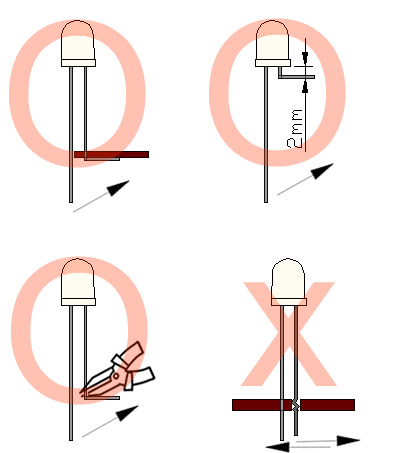
During lead forming, the leads should be bent at a point at least 3mm from the base of LED lens. Do not use
the base of the leadframe as a fulcrum during forming.
Lead forming must be done before soldering, at normal temperature.
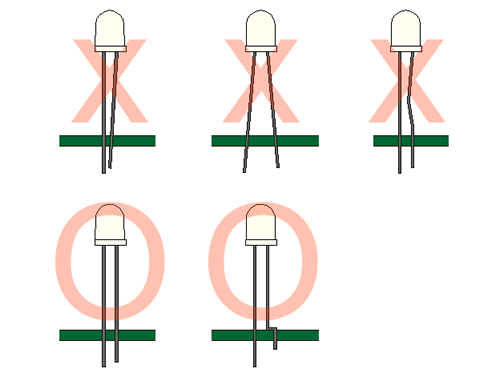
During assembly on PCB, use minimum clinch force possible to avoid excessive mechanical stress.
Soldering
When soldering, leave a minimum of 2mm clearance from the base of the base of the lens to the soldering point. Dipping the lens into the solder must be avoided.
Do not apply any external stress to the lead frame during soldering while the LED is at high temperature.
Recommended soldering conditions:
| IR Reflow Soldering (for SMD display) | Wave Soldering | Soldering Iron | |||
| Pre-Heat | 150-180°C | Pre-Heat | 100°C Max. | Temperature | 300°C Max. |
| Pre-Heat Time | 120sec Max. | Pre-Heat Time | 60sec Max. | ||
| Peak Temperature | 260°C Max. | SolderWave | 260°C Max. | Soldering Time | 3sec Max.(one time only) |
| Soldering Time | 10 sec Max. | Soldering Time | 5sec Max. | ||
Note: Excessive soldering temperature and/or time might result in deformation of the LED lens or failure of the LED
ESD(Electrostatic Discharge)
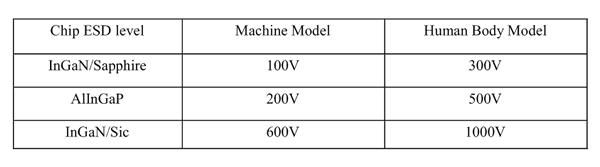
Static Electricity or power surge will damage the LED.
Suggestions to prevent ESD (Electrostatic Discharge):
n Use a conductive wrist band or anti-electrostatic glove when handling these LEDs
n All devices, equipment, and machinery must be properly grounded
n Work tables, storage racks, etc. should be properly grounded
n Use ion blower to neutralize the static charge which might have built up on surface of the LED’s
plastic lens as a result of friction between LEDs during storage and handling
ESD-damaged LEDs will exhibit abnormal characteristics such as high reverse leakage current,
low forward voltage, or “no light on” at low currents. To verify for ESD damage, check for “light on”
and Vf of the suspect LEDs at low currents.
The Vf of “good” LEDs should be>2.0V@0.1mA for InGaN product and >1.4V@0.1mA for AlInGaP
product.
Drive Method
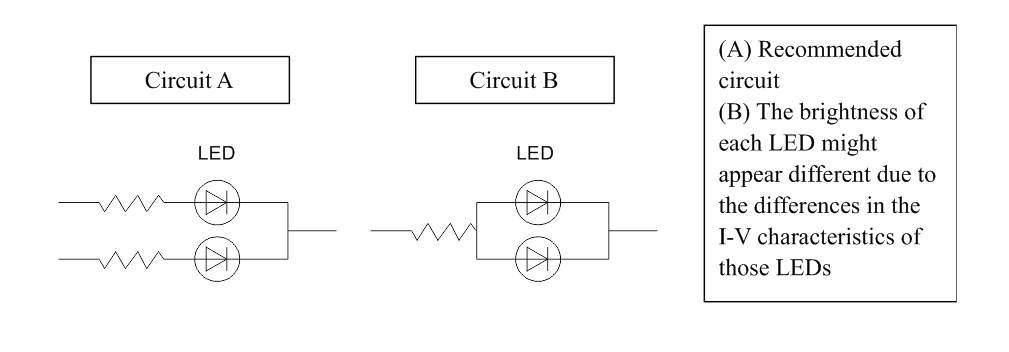
An LED is a current-operated device. In order to ensure intensity uniformity on multiple LEDs connected in
parallel in an application, it is recommended that a current limiting resistor be incorporated in the drive circuit,
in series with each LED as shown in Circuit A below.
When selecting power for LED systems, it’s essential to understand several key parameters to ensure safe operation, longevity, and optimal performance. Here are some steps and considerations for LED power selection:
- Determine the Forward Voltage (Vf) of the LED(s):
Each LED has a forward voltage, which is the voltage at which the LED operates when the current is flowing through it. This value can typically be found in the LED’s datasheet.
- Determine the Forward Current (If) of the LED(s):
The forward current is the current at which the LED is designed to operate. Running an LED at higher than its rated current can reduce its lifespan and increase the heat it produces.
- Decide on the Configuration:
Series Configuration: When LEDs are connected in series, the forward voltages add up, but the current remains the same.
Parallel Configuration: When LEDs are connected in parallel, the forward voltage remains the same, but the currents add up. This configuration can be risky because if one LED fails or has a slightly lower forward voltage, it can cause the other LEDs to draw more current.
Calculate Total Power Requirements:
Power (W) = Total Forward Voltage (V) x Total Forward Current (A)
For example, if you have three LEDs connected in series, each with a forward voltage of 3V and a forward current of 20mA, the total power requirement would be:
Power = (3V + 3V + 3V) x 20mA = 9V x 0.02A = 0.18W
- Select an Appropriate Power Supply:
- Voltage Rating: The power supply voltage should match or slightly exceed the total forward voltage of your LED configuration.
- Current Rating: The power supply’s current rating should meet or exceed the total forward current of your LED configuration.
- Safety Margin: It’s a good practice to select a power supply that can provide at least 20% more power than your calculated requirement. This ensures the power supply isn’t operating at its maximum capacity, which can extend its life and ensure safer operation.
- Consider Additional Features:
- Dimming Capability: If you want to control the brightness of your LEDs, choose a power supply with dimming capabilities.
- Overcurrent and Overvoltage Protection: To protect your LEDs, select a power supply with built-in protection mechanisms.
- Thermal Management: Ensure that the power supply has adequate cooling, especially if it will be enclosed or in a location with limited airflow.
- Regulation and Efficiency:A power supply with good regulation will maintain a consistent voltage output despite variations in the load. High efficiency ensures minimal power is wasted as heat.
- Physical Size and Form Factor:Depending on where you plan to place the power supply, its size and shape may be critical factors.
In summary, when selecting power for LED systems, understanding your LED’s requirements and the configuration you plan to use is essential. Then, pick a power supply that meets those needs with some added safety margin, keeping in mind any additional features or constraints relevant to your project.
Here are some well-regarded brands in the industry:
- Mean Well: One of the most recognized brands in the LED power supply industry, Mean Well offers a wide range of products suitable for both indoor and outdoor applications. Their units often come with features like overcurrent protection, dimming capabilities, and high efficiency.
- Tridonic: A global leader in lighting technology, Tridonic offers LED drivers and power supplies that cater to various lighting solutions, from simple setups to advanced smart lighting systems.
- Philips Advance Xitanium: Philips is a well-known brand in the lighting industry, and their Xitanium series of LED drivers are known for reliability and performance. They cater to both indoor and outdoor LED applications.
- Osram: Another giant in the lighting industry, Osram offers a range of LED drivers and power supplies suitable for various applications, including architectural and street lighting.
- LIFUD: Specializing in LED drivers, LIFUD is known for its high-quality products that cater to both commercial and residential LED lighting solutions.
- MOSO: This brand offers a variety of LED drivers, especially for outdoor and industrial applications. Their products are known for durability and performance.
- TDK-Lambda: With a history in power electronics, TDK-Lambda offers a range of power supplies and LED drivers suitable for various applications, emphasizing reliability and advanced features.