Product Series |
|---|
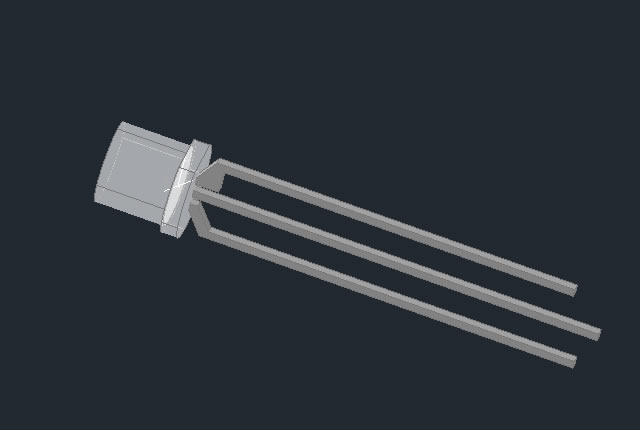 Series No:BL-L549 Dimension 5 × 5.8 × 5.3 mm Description: ___________________________________________________________________________________________________________________________________________________ “High-Precision Dual-Color Illumination: The 5mm Cylindrical LED (Bi-Color, 3 Leads)” IntroductionThe 5mm cylindrical LED is one of the most reliable and widely used LED types in modern electronics. When designed as a bi-color version with 3 leads, it becomes even more versatile, offering multiple illumination modes in a single compact package. The LED 5mm bi-color format provides two distinct light colors—commonly red/green, red/yellow, or red/blue—controlled through polarity or signal logic. This configuration makes it ideal for applications that require multi-status indicators in limited space, such as industrial control panels, electronic instruments, and consumer devices. Engineers and product designers prefer the 5mm cylindrical LED for its long operational life, high brightness, and consistent color output. Its classic cylindrical shape and 5mm round LED size allow for easy installation in PCBs, instrument panels, and display modules. As a cylindrical LED, it combines traditional design stability with advanced color functionality, meeting both aesthetic and technical requirements. Features of the 5mm Cylindrical Bi-Color LED (3 Leads)The 5mm cylindrical LED with three leads is engineered for precision and flexibility. Below are its defining technical and structural features that make it stand out among similar LEDs:
Applications of 5mm Cylindrical Bi-Color LEDsThe 5mm cylindrical LED is an essential component across a broad range of industries. Its compact size and dual-color function make it a favorite for space-efficient systems requiring clear visual feedback. 1. Industrial Control PanelsUsed extensively in automation systems, the LED 5mm bi-color provides immediate visual status cues—green for active, red for fault, and both combined for transitional states. 2. Power Supply IndicatorsIn power modules and converters, the cylindrical LED acts as a dual-state indicator, signaling ON/OFF or voltage variations through color changes. 3. Consumer ElectronicsCommonly used in audio amplifiers, chargers, and home appliances, the 5mm cylindrical LED improves user interface feedback by providing intuitive, color-coded indicators. 4. Communication DevicesIn telecommunication systems, 5mm round LEDs serve as line activity or signal status indicators, with dual colors simplifying monitoring. 5. Automotive ElectronicsThe LED’s durability makes it suitable for dashboards and signal systems, providing multi-function visual indicators for safety and diagnostics. 6. Educational Kits and PrototypingHobbyists and students utilize LED 5mm bi-color diodes in Arduino and Raspberry Pi projects for learning circuit logic and color control. Benefits of Using the 5mm Cylindrical Bi-Color LEDThe 5mm cylindrical LED offers multiple operational advantages, combining reliability, cost-effectiveness, and visual performance.
Case StudiesCase Study 1 – Automation Control Systems (Germany)A German manufacturer integrated the 5mm cylindrical LED into programmable logic controllers (PLCs). The LED 5mm bi-color provided dual-status feedback—green for “active” and red for “fault.” This reduced operator error rates and increased monitoring efficiency by 30%. Case Study 2 – Consumer Electronics (Japan)A Japanese audio equipment company used the cylindrical LED for power and recording status in its amplifier series. The LED’s dual-color function simplified the interface design while enhancing aesthetic appeal. Case Study 3 – Renewable Energy Monitors (USA)An American solar power company adopted the 5mm round LED in its charge controllers to indicate charging and full-charge states. Its reliability in fluctuating temperature conditions proved essential for outdoor use. User TestimonialsThomas H., Electronics Engineer (UK): Yuki M., Product Designer (Japan): Alex R., Embedded Systems Developer (Canada): Integration and Design ConsiderationsTo ensure optimal performance of your 5mm cylindrical LED, it’s important to follow best practices for circuit design and installation:
ConclusionThe 5mm cylindrical LED, bi-color with 3 leads, represents the perfect balance between compact design, functionality, and efficiency. Its dual-color emission and simple control configuration make it indispensable in professional and hobbyist applications alike. From industrial control panels to smart home devices, the LED 5mm bi-color provides engineers and designers with a reliable and visually appealing light solution. Durable, energy-efficient, and easy to integrate, this cylindrical LED continues to set the standard for multi-state indication technology. For anyone seeking precision and performance in a small form factor, the 5mm round LED remains the ideal component for both legacy and next-generation electronic systems.  Features
Applications
___________________________________________________________________________________________________________________________________________________ Dimension and Circuit Drawing: 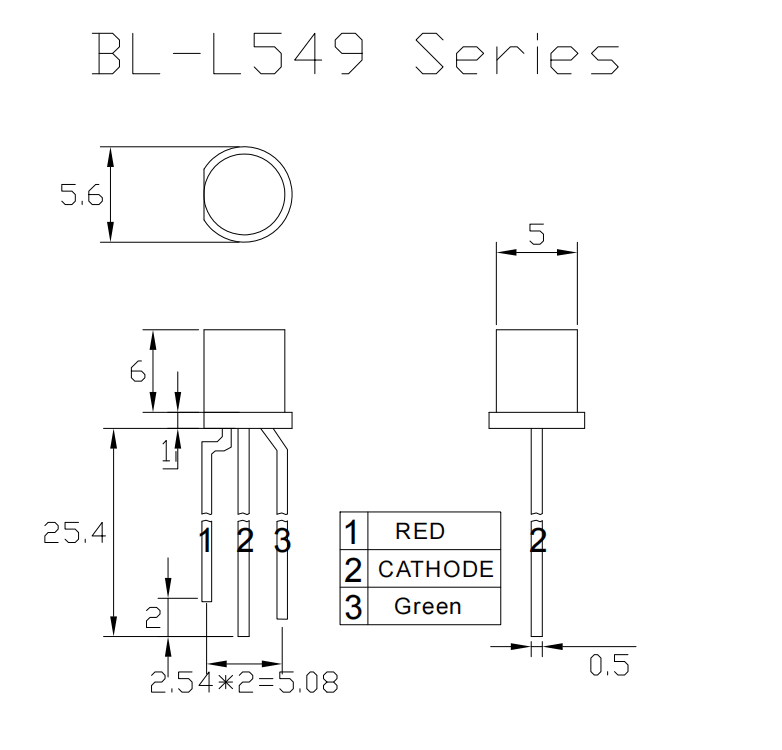 |
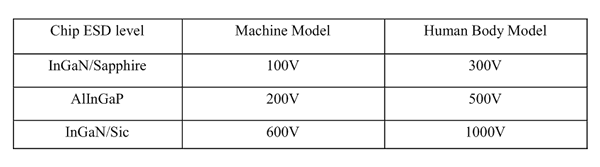
ESD(Electrostatic Discharge)
Static Electricity or power surge will damage the LED.
Suggestions to prevent ESD (Electrostatic Discharge):
n Use a conductive wrist band or anti-electrostatic glove when handling these LEDs
n All devices, equipment, and machinery must be properly grounded
n Work tables, storage racks, etc. should be properly grounded
n Use ion blower to neutralize the static charge which might have built up on surface of the LED’s
plastic lens as a result of friction between LEDs during storage and handling
ESD-damaged LEDs will exhibit abnormal characteristics such as high reverse leakage current,
low forward voltage, or “no light on” at low currents. To verify for ESD damage, check for “light on”
and Vf of the suspect LEDs at low currents.
The Vf of “good” LEDs should be>2.0V@0.1mA for InGaN product and >1.4V@0.1mA for AlInGaP
product.