 Datasheet
 “Bright Efficiency: Exploring the Power of the 2835 0.5W & 1W SMD LED Diode”
Introduction
In the evolving world of lighting and electronic components, the 2835 LED has become one of the most widely adopted and trusted light-emitting diodes in modern design. Known for its compact dimensions, high luminous efficiency, and stability, this LED is the backbone of both consumer and industrial lighting systems. The 2835 0.5W and 1W SMD LED diode offers a balance between energy savings and brightness, making it a top choice for applications such as indoor lighting, automotive electronics, signage, and portable devices.
The white LED technology used in this model provides clean, consistent illumination, ideal for projects that demand high reliability and color accuracy. When integrated into a well-designed LED circuit, the 2835 package delivers outstanding light output while maintaining low thermal resistance — a critical factor in long-term performance.
Whether you’re an electronics engineer, lighting designer, or component purchaser, understanding the design, benefits, and applications of the SMD 2835 LED will help you make the right choice for your next project.
Features of the 2835 SMD LED Diode
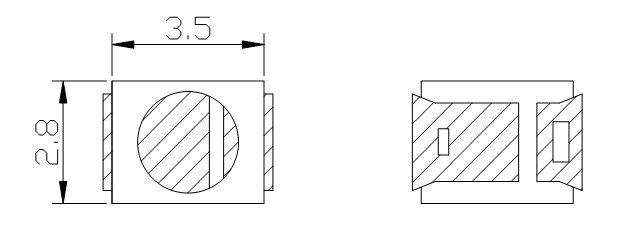
The 2835 LED is named after its dimensions — 2.8mm × 3.5mm — and represents a major advancement in surface-mount LED technology. Designed to offer high brightness in a small footprint, it outperforms older packages such as the 3528 or 5050 LEDs in efficiency and thermal management.
Key Features:
-
High Luminous Efficacy:
The 2835 LED delivers up to 150–180 lumens per watt depending on color temperature, ensuring optimal brightness with minimal power consumption. -
Versatile Power Options:
Available in 0.5W and 1W versions, allowing flexibility for both low-power and high-intensity lighting applications. -
Superior Thermal Management:
Built with an advanced heat-dissipating substrate, the diode ensures long operational life and stable output even in demanding environments. -
Consistent Color Temperature:
The white LED is available in multiple color tones — from warm white (2700K) to cool white (6500K) — making it suitable for both decorative and industrial lighting. -
Wide Viewing Angle:
The LED emits light uniformly, typically between 120°–140°, ideal for even illumination across surfaces. -
Surface Mount Technology (SMD):
Compact design simplifies assembly in mass production and ensures compatibility with standard automated soldering processes. -
Long Lifespan:
With proper LED circuit design, the 2835 LED can last up to 50,000 hours, significantly reducing maintenance and replacement costs.
Applications of the 2835 0.5W and 1W SMD LED
The 2835 SMD LED diode has a wide range of applications across industries, thanks to its adaptability, brightness, and reliability.
-
General Illumination:
Used extensively in LED bulbs, tube lights, and ceiling panels. The white LED output ensures clear and natural lighting for residential and commercial spaces. -
Automotive Lighting:
The 2835 LED is ideal for car interior lights, brake lights, and daytime running lamps (DRLs), where brightness and durability are critical. -
Signage and Display Panels:
Its high intensity and even light distribution make it perfect for advertising boards and digital displays. -
Backlighting Applications:
Found in LCD screens, control panels, and display backlights due to its uniform brightness and low energy usage. -
Industrial and Medical Equipment:
The SMD 2835 LED is trusted in instruments that require high precision and stable color output, such as scanners and optical sensors. -
Portable and Consumer Electronics:
Commonly used in flashlights, wearable devices, and battery-operated electronics where efficiency is key.
Benefits of the 2835 LED Technology
The success of the 2835 LED lies in its ability to combine brightness, efficiency, and reliability in a compact form factor. Below are the main advantages that make it a preferred choice for engineers and product designers.
-
Energy Efficiency:
Delivers more lumens per watt compared to traditional LEDs, resulting in significant energy savings. -
Low Heat Generation:
The 2835 LED runs cooler due to its superior thermal design, extending component and fixture life. -
High Color Rendering (CRI):
Produces natural, vibrant lighting that enhances color visibility in retail and display settings. -
Durability:
Resistant to shock and vibration, the SMD 2835 LED ensures long-term reliability in rugged environments. -
Compact Integration:
Its surface-mount design allows easy incorporation into space-limited designs, especially in high-density LED circuit configurations. -
Cost Efficiency:
Offers an optimal balance between cost, performance, and longevity, reducing both production and operational expenses.
Optimizing LED Circuit Design
For best performance, the 2835 LED should be integrated into a well-engineered LED circuit. Proper current regulation, heat dissipation, and voltage matching are key to ensuring stable operation and long life.
-
Use Constant Current Drivers:
This stabilizes output brightness and prevents fluctuations that can shorten LED life. -
Implement Adequate Heat Sinking:
High-efficiency materials like aluminum PCBs improve thermal dissipation for the 1W SMD LED models. -
Ensure Proper Soldering:
Automated reflow soldering with precise temperature control helps maintain performance integrity. -
Test for Voltage Drop:
In high-density LED circuits, maintaining uniform voltage across all LEDs prevents uneven brightness and premature failure.
Case Studies
Case Study 1 – Energy-Efficient Lighting (UK):
A commercial lighting company replaced its legacy bulbs with 2835 LEDs in a 500,000 sq. ft. warehouse. The result was a 40% reduction in power consumption and 30% longer operational life, with no noticeable color shift over time.
Case Study 2 – Automotive Instrumentation (Japan):
A leading car manufacturer integrated SMD 2835 LEDs into dashboard lighting systems. Engineers reported a 25% improvement in brightness uniformity and greater design flexibility for curved panels.
Case Study 3 – Retail Display Solutions (USA):
A display equipment supplier upgraded its lightboxes with 2835 1W white LEDs. The new setup delivered enhanced color vibrancy and reduced flicker, improving visual impact for customers.
User Testimonials
John Miller, Senior Electronics Engineer (USA):
“The 2835 LED is one of the most efficient components we’ve tested. Its consistency and brightness outperform other SMD types in the same category.”
Mei Lin, Product Designer (China):
“We use the white LED 2835 in multiple applications—from panel lights to displays. It offers great heat resistance and color stability.”
Oliver Hughes, Purchasing Manager (UK):
“Reliable supply, high lumen output, and competitive pricing make the SMD 2835 LED our standard component for mass production.”
Conclusion
The 2835 0.5W and 1W SMD LED diode has set a new benchmark in modern LED design, providing engineers and manufacturers with a component that excels in performance, energy efficiency, and versatility.
Whether used in home lighting, industrial systems, or automotive applications, the 2835 LED consistently delivers superior brightness, long lifespan, and robust reliability. When paired with a properly optimized LED circuit, it ensures stable operation and enhanced illumination across all environments.
Compact, cost-effective, and durable, the SMD 2835 LED continues to shape the future of lighting technology — driving innovation and sustainability for a brighter tomorrow.

Features
- Power SMD LEDs, 2.8mm x0.55mm, 1.9mm Thickness, PLCC2 Package: These Surface-Mount Device (SMD) LEDs are compact and housed in a PLCC2 (Plastic Leaded Chip Carrier) package, designed for power applications in a small form factor.
- Mono-Color Type with Ultra Brightness: They provide a single-color light output with high luminosity, suitable for applications requiring intense light.
- Power Ratings of 0.5W and 1W: Available in two power variants, 0.5 watts and 1 watt, catering to different intensity and energy consumption needs.
- Compatible with Automatic Placement Equipment: Designed for seamless integration with automated assembly systems, allowing for efficient, high-speed placement on circuit boards.
- Wide Viewing Angle: The LEDs offer a broad viewing angle, ensuring visibility from different perspectives, crucial in many display and signaling applications.
- Ideal for Backlight and Indicator: Perfectly suited for use as a backlight in various types of displays or as an indicator light in electronic devices.
- Packaged 2,000 Pieces per Reel: Supplied in bulk with 2,000 pieces per reel, which is ideal for large-scale production and facilitates efficient handling.
- RoHS Compliance: Manufactured in compliance with the Restriction of Hazardous Substances directive, ensuring reduced environmental impact and safety in use.
Applications
- Backlighting for Displays: Suitable for backlighting LCDs, control panels, and keypads in various electronic devices.
- High-Intensity Indicator Lights: Ideal for use as status indicators in machinery, automotive dashboards, and electronic appliances where high brightness is necessary.
- Consumer Electronics: Can be used in personal electronic devices like smartphones, tablets, and laptops, especially where intense backlighting is required.
- Automotive Lighting: Suitable for both interior and exterior lighting in vehicles, such as dashboard lights, accent lighting, and external signal lights.
- Portable Electronics: Due to their power efficiency and compact size, they are well-suited for battery-operated devices.
- Illumination in Compact Spaces: Their small size makes them ideal for lighting in confined spaces, such as in portable medical devices or handheld tools.
- Decorative Lighting: Can be used in architectural lighting, home decor, and ambient lighting setups due to their high brightness and compact size.
- Safety and Emergency Lighting: Appropriate for use in emergency lighting systems and safety equipment, where high visibility is essential.


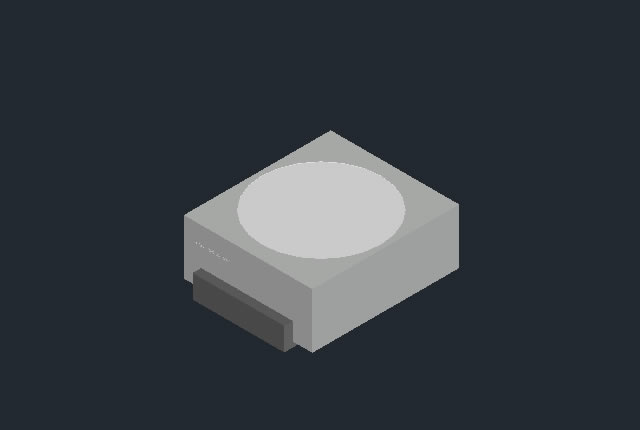
Obtain 3D specification files
 Initial Graphics Exchange Specification (.IGS)Standard for the Exchange of Product Model Data (.STEP)
To examine all 3D specifications, save the files to your local drive and open them with your 3D application.
Lens colors in 3D files are solely for visual representation; consult the Datasheet for accurate lens type and color information.
In the event of a mismatch, the dimensions in the datasheet take precedence over the 3D specifications.
LEDs, Light Emitting diodes, which include various small kinds, such as 3mm, 5mm, 8mm, 10mm; round type, rectangular type square type, tower type, Oval led, elliptical, flat top; SMDs, high power led, piranha LEDs

Applied for:



The LEDs described here are intended to be used for ordinary electronic equipment (such as office equipment,
communication equipment and household applications). Consult Betlux’s Sales in advance for information on
applications in which exceptional reliability is required, particularly when the failure or malfunction of the LEDs
may directly jeopardize life or health (such as in aviation, transportation, traffic control equipment, medical
and life support systems and safety devices).
CAUTIONS for Through-Hole LED Lamps
1. Application
The LEDs described here are intended to be used for ordinary electronic equipment (such as office equipment, communication equipment and household applications). Consult Betlux’s Sales in advance for information on applications in which exceptional reliability is required, particularly when the failure or malfunction of the LEDs may directly jeopardize life or health (such as in aviation, transportation, traffic control equipment, medical and life support systems and safety devices).
2. Storage
The storage ambient for the LEDs should not exceed 30℃ temperature or 70% relative humidity. It is
recommended that LEDs out of their original packaging are used within three months
For extended storage out of their original packaging, it is recommended that the LEDs be stored in a sealed
container with appropriate desiccant or in a desiccator with nitrogen ambient.
3. Cleaning
Use alcohol-based cleaning solvents such as isopropyl alcohol to clean the LED if necessary
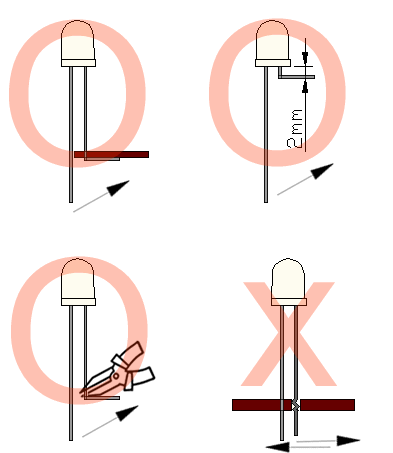
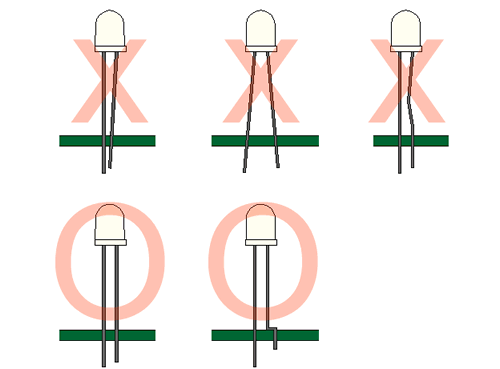
4. Lead Forming & Assembly
During lead forming, the leads should be bent at a point at least 3mm from the base of LED lens. Do not use
the base of the leadframe as a fulcrum during forming.
Lead forming must be done before soldering, at normal temperature.
During assembly on PCB, use minimum clinch force possible to avoid excessive mechanical stress.
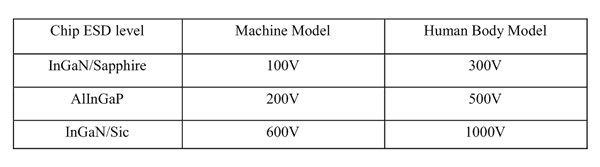
ESD(Electrostatic Discharge)
Static Electricity or power surge will damage the LED.
Suggestions to prevent ESD (Electrostatic Discharge):
n Use a conductive wrist band or anti-electrostatic glove when handling these LEDs
n All devices, equipment, and machinery must be properly grounded
n Work tables, storage racks, etc. should be properly grounded
n Use ion blower to neutralize the static charge which might have built up on surface of the LED’s
plastic lens as a result of friction between LEDs during storage and handling
ESD-damaged LEDs will exhibit abnormal characteristics such as high reverse leakage current,
low forward voltage, or “no light on” at low currents. To verify for ESD damage, check for “light on”
and Vf of the suspect LEDs at low currents.
The Vf of “good” LEDs should be>2.0V@0.1mA for InGaN product and >1.4V@0.1mA for AlInGaP
product.
Drive Method
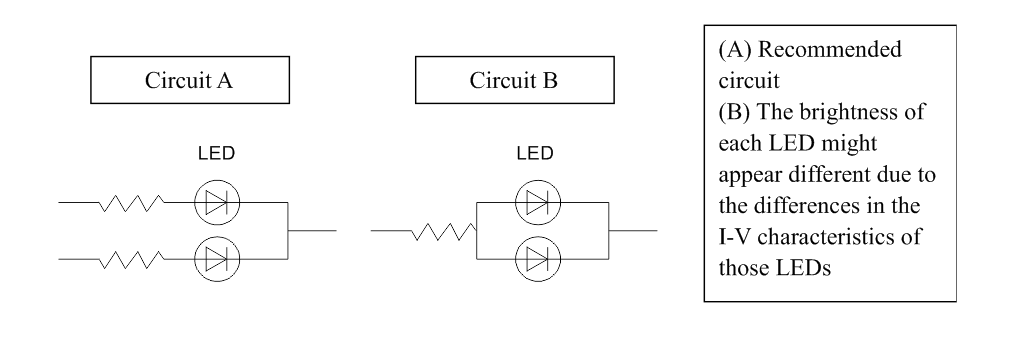
An LED is a current-operated device. In order to ensure intensity uniformity on multiple LEDs connected in
parallel in an application, it is recommended that a current limiting resistor be incorporated in the drive circuit,
in series with each LED as shown in Circuit A below.