

 Datasheet
 Obtain 3D specification files
 Initial Graphics Exchange Specification (.IGS)Standard for the Exchange of Product Model Data (.STEP)
To examine all 3D specifications, save the files to your local drive and open them with your 3D application.
Lens colors in 3D files are solely for visual representation; consult the Datasheet for accurate lens type and color information.
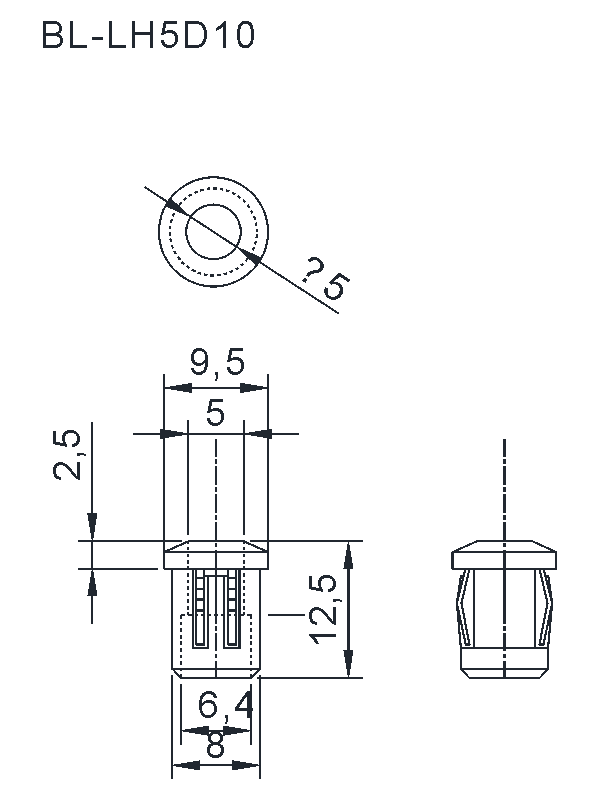
In the event of a mismatch, the dimensions in the datasheet take precedence over the 3D specifications.
The Professional’s Guide to 5mm LED Housing: Precision, Protection, and Plastic Material Mastery
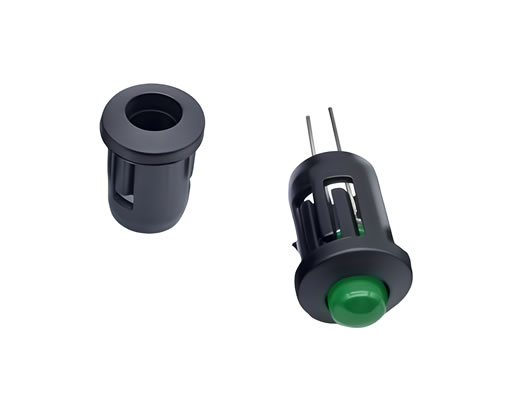
In the high-stakes world of electronics manufacturing, the difference between a « prototype » look and a finished professional product often lies in the smallest details. One such detail that carries immense weight is the 5mm LED housing. For engineers and procurement administrators, selecting the correct LED housing is not merely a cosmetic choice; it is a functional necessity that ensures component longevity, user safety, and assembly efficiency. By utilizing a high-quality 5mm LED housing, manufacturers can secure standard T-1 ¾ (5mm) light-emitting diodes to front panels with precision, ensuring that the visual interface remains robust even in demanding environments. This article delves into the critical aspects of 5mm LED plastic housing, exploring why this specific material choice is the industry standard for modern electronics.
Anatomy of Effectiveness: Features of 5mm LED Housing
The 5mm LED housing acts as the interface between the fragile semiconductor component and the external world. While metal options exist, the industry predominantly favors plastic LED housing due to its unique combination of versatility and electrical properties.
Material Science: Nylon 66 and Polycarbonate
Most professional-grade 5mm LED plastic housing units are manufactured from Nylon 66 or high-grade polycarbonate. These materials are chosen for their excellent balance of rigidity and flexibility. A high-quality plastic LED housing must withstand the heat generated by the LED junction without deforming. Nylon 66, for instance, offers high thermal resistance and is often rated UL94V-0 for flame retardancy, a non-negotiable compliance standard for many industrial electronics.
Mechanical Design: The Snap-In Advantage
A defining feature of the 5mm LED housing is its mounting mechanism. Unlike complex metal bezels that may require threaded nuts and washers, a 5mm LED plastic housing typically features a self-retaining « snap-in » design. This allows the housing to expand slightly as it is pushed through the panel cutout and then snap securely back into place. This design reduces assembly time by nearly 50% compared to screw-mount alternatives, a massive benefit for high-volume manufacturing lines.
Applications Across Industries
The versatility of the 5mm LED plastic housing makes it a staple component across a broad spectrum of sectors.
-
Industrial Control Panels: In factory automation, indicators must remain visible and secure despite heavy vibration. A plastic LED housing absorbs minor vibrations that might otherwise crack a soldered joint, ensuring the « System Active » or « Warning » lights remain functional.
-
Network and Telecommunications: Routers, modems, and server blades utilize 5mm LED housing arrays to provide clear status indicators (Power, LAN, Wi-Fi) without light bleeding between adjacent ports.
-
Medical Instrumentation: Reliability is paramount in healthcare. The 5mm LED plastic housing provides a dielectric barrier, insulating the user from internal circuitry—a critical safety feature in patient-monitoring devices.
-
Automotive Dashboards: Aftermarket and OEM dashboard modifications often rely on 5mm LED plastic housing to install alarm indicators or shift lights cleanly into plastic trim pieces.
Why Choose Plastic? The Benefits of 5mm LED Plastic Housing
While metal housings have their place in extreme vandal-prone environments, the 5mm LED plastic housing offers distinct advantages for general and industrial electronics.
Electrical Insulation and Safety
The primary benefit of a plastic LED housing is its inherent electrical insulation. In a metal chassis, using a metal holder requires careful isolation to prevent short circuits. A plastic LED housing naturally eliminates this risk, simplifying the design and reducing the need for extra insulating washers.
Cost-Effectiveness
For a purchaser, the bottom line is critical. Plastic LED housing units are significantly more cost-effective to manufacture (via injection molding) than machined metal counterparts. This cost saving scales massively in volume production without sacrificing the aesthetic quality of the final product.
Optical Enhancement
Many 5mm LED plastic housing units are designed with internal geometries that help guide light. A black nylon housing provides high contrast, making the LED color pop, while a clear or diffused plastic LED housing can widen the viewing angle, ensuring the indicator is visible from the side—a feature often referred to as « wide-angle diffusion. »
Case Studies: Real-World Success
Case Study 1: The Industrial Retrofit
Global Automation Ltd. faced a high failure rate in their PLC interface panels. The LEDs were soldered directly to the PCB and protruded through holes in the metal enclosure. Mechanical vibration caused the LED legs to fatigue and snap. Solution: The engineering team introduced a 5mm LED housing with a panel-mount clip. Result: The 5mm LED plastic housing mechanically decoupled the LED from the panel, reducing stress on the solder joints. Field failures dropped by 90%, and the panel aesthetics improved significantly, leading to higher customer satisfaction.
Case Study 2: The Medical Device Upgrade
MediTech Solutions was developing a handheld diagnostic tool. The original design used a simple drilled hole for the status light, but users complained of « light bleed » where the internal light reflected inside the casing, confusing the reading. Result: By integrating a black plastic LED housing, the light was collimated and directed solely toward the viewer. The 5mm LED plastic housing acted as a light baffle, sharpening the signal and improving the device’s perceived quality.
User Testimonials
« As a manufacturing engineer, I prioritize components that speed up assembly. The snap-fit 5mm LED housing we switched to has cut our front-panel assembly time in half. It’s a small part, but the impact on our throughput is huge. » — James T., Senior Manufacturing Engineer, ElectroSystems Inc.
« We used to overlook the housing and just let the LEDs poke through the casing. Switching to a proper 5mm LED plastic housing completely changed the look of our products. They look finished, professional, and rugged now. Our distributors noticed the quality bump immediately. » — Sarah L., Product Designer, Apex Audio
« Sourcing reliable plastic LED housing suppliers has been a key part of our cost-reduction strategy. We get better electrical isolation and lower unit costs compared to the old chrome bezels we used to buy. It’s a win-win for our budget and our safety certification. » — Mark D., Procurement Administrator, Network Solutions Corp.
Conclusion
The humble 5mm LED housing is a powerhouse component that solves mechanical, electrical, and aesthetic challenges in one go. Whether you are mitigating vibration in industrial machinery or ensuring patient safety in medical devices, the 5mm LED plastic housing offers the reliability and performance modern electronics demand. By selecting the right plastic LED housing, you ensure your product not only functions perfectly but also conveys a sense of quality and durability to the end-user.


